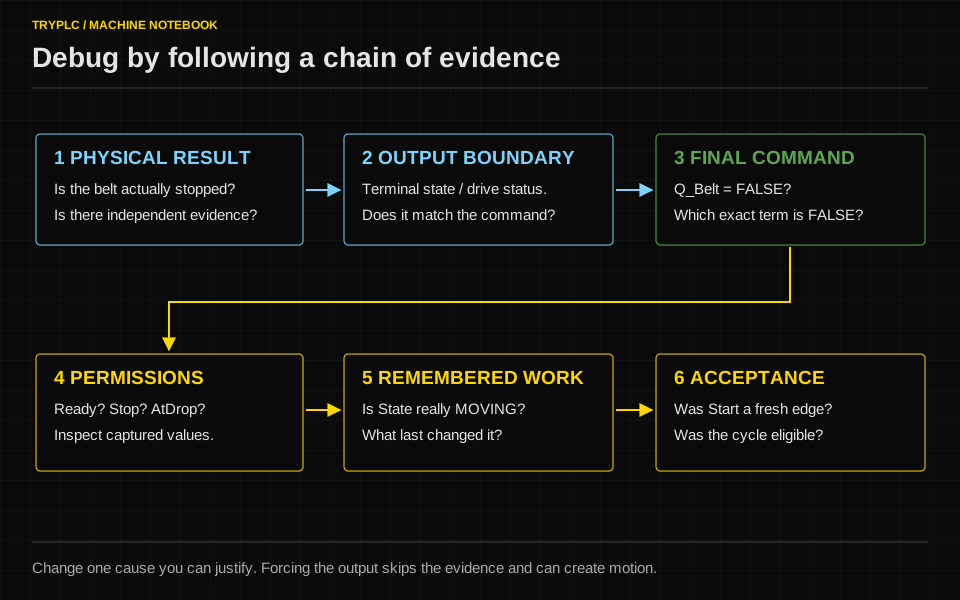
If Q_Belt is FALSE, inspect the terms that own that decision. If Q_Belt is TRUE but the physical drive input is absent, move outward toward mapping, communication and electrical evidence. If the drive runs but the carton stays still, inspect the mechanical process and arrival supervision. Each observation narrows the search to a different layer. A useful hypothesis names the expected difference before you change anything.
Stop asking which line looks wrong
The model transfer conveyor stops halfway through a tray movement. You notice a timer preset, a sensor filter, and a sequence transition. All three look suspicious. Changing all three may make the animation finish, but you will not know what failed or whether it can fail again.
Debugging begins with a narrower question: what is the first observable difference between intended and actual behavior? If the motor request disappears at 1.24 seconds, investigate why it disappeared. Do not start by increasing a four-second arrival timeout. That timeout has not yet expired.
A professional does not need to guess correctly on the first attempt. They need a method that makes each attempt informative.
Preserve the failure before improving it
Record the software revision, parameters, initial state, input sequence, and observed result. Save the smallest trace that contains the event and enough preceding history to explain it. If the failure is intermittent, record occurrence frequency and what changed between successful and failed cycles.
In the browser model, reset to a known initial condition and replay the same disturbances. On an actual machine, reproducing a fault may be unsafe or disruptive; investigation must follow the site's authorized conditions. Sometimes the correct next step is analysis of existing records rather than another physical trial.
Write the symptom without a diagnosis: “Motor request became false while Transfer was active and no arrival had been accepted.” Avoid “The timer is broken.” The first sentence preserves possibilities. The second encourages you to ignore contrary evidence.
Follow the chain backward
A useful cause chain for a stopped conveyor is:
Physical conveyor stopped
  ← drive stopped producing motion
  ← drive command or permission changed
  ← final motor request changed
  ← sequence request or production permission changed
  ← sampled signal, state, parameter, or diagnostic changed
Start at the earliest level you can observe reliably. A green HMI icon is not proof of a drive command if the display updates slowly or uses a different tag. Compare the exact variables and timestamps.
Suppose the trace shows TransferState = Moving, SequenceRunRequest = TRUE, and MotorRun = FALSE. That directs attention to output arbitration or permissions, not the transition out of Moving. If MotorRun = TRUE throughout the stop, ordinary sequencing may be innocent; the command path, drive status, feedback, or plant model needs investigation.
Build a hypothesis table
For the model fault, collect this trace:
| Time | Moving | Sequence request | Motor request | Downstream ready |
|---|---|---|---|---|
| 1.22 s | True | True | True | True |
| 1.23 s | True | True | True | True |
| 1.24 s | True | True | False | False |
| 1.25 s | True | True | True | True |
Now state competing explanations and predictions:
| Hypothesis | Prediction | Distinguishing observation |
|---|---|---|
| Arrival timeout expired | Timer Q becomes true | Q remains false, so reject |
| Downstream readiness gates motion continuously | Motor follows a ready glitch | Matches trace; inspect interface contract |
| Another routine overwrites MotorRun | Last writer changes value | Cross-reference and task trace |
Do not stop at correlation. Downstream readiness and motor request may share a third cause. Inspect the actual assignment and task ownership to test causation.
Find the design mistake behind the symptom
The code contains:
MotorRun := SequenceRunRequest AND DownstreamReady;This may be correct for one interface and wrong for another. In our model, downstream readiness means “I can accept a new tray.” After accepting the transfer, the downstream station withdraws readiness to prevent a second reservation. The local conveyor mistakenly interprets that withdrawal as “stop the accepted transfer.”
Adding a sensor filter would hide the issue only while the withdrawal remained short. Increasing the timeout would allow a longer wrong behavior. The root correction is an interface contract: acceptance reserves the destination for this transaction, and motion follows that accepted transaction until completion or an explicit abort condition.
Update the requirement and interface diagram before editing the expression. A debug session often discovers an incomplete design, not a misspelled variable.
One change, one prediction
Change the model to latch an accepted transfer under a transaction identifier. Do not simultaneously adjust speed, timeout, and sensor filtering. Predict the result: readiness withdrawal after acceptance will not interrupt the accepted movement; readiness false before acceptance will still block it.
Run both tests. Then run explicit abort and communication-loss tests. Removing a continuously evaluated ready condition must not accidentally ignore a different stop requirement. The corrected contract should distinguish readiness, acceptance, completion, and loss of permission.
When a result contradicts your prediction, revise the hypothesis. Do not keep layering conditions until the visible symptom disappears. That produces programs nobody can explain and regressions nobody can confidently isolate.
Timing deserves its own evidence
Many PLC faults involve events that are individually correct but ordered badly. A completion bit may be raised and cleared between HMI polls. A pulse may be shorter than the receiving task interval. Two tasks may read different generations of shared data. A timer may be conditionally skipped, retaining internal state longer than expected.
Log event identifiers or counters when a short pulse is hard to observe. Record both the sender's transition and the receiver's acknowledgement. Use the controller's appropriate tracing tools on hardware, with attention to acquisition rate, task loading, and timestamp meaning. Increasing trace frequency does not automatically create perfect information.
For a browser exercise, deliberately vary the communication delay independently of the control step. You should be able to explain which contract still holds when the screens update slowly. A robust handshake does not require two displays to blink together.
Leave a useful repair record
A repair note should explain symptom, cause, correction, affected requirements, and verification. “Fixed conveyor bug” is almost useless six months later. “Reserved-transfer state replaces continuous Ready gating; verified readiness withdrawal after acceptance, pre-acceptance blocking, abort, and stale-communication handling” preserves the reasoning.
If the diagnosis remains uncertain, say so. A temporary containment can be appropriate under the project's authority, but label it and define the evidence needed for a permanent correction. Do not promote a lucky parameter change into a proven root cause.
Try it
An actuator sometimes reports a travel timeout immediately after reset. The timer is called only while State = Moving. Reset changes the state to Idle, and the next start returns it to Moving. Propose a hypothesis, a decisive trace, and a correction to test. Assume the selected timer retains its instance state until called with a resetting input.
Work through the answer
The hypothesis is that leaving Moving stops execution of the timer without resetting its internal state. On the next entry, its old completion state is still present. Trace the timer's invocation, IN, Q, elapsed value, and sequence state across fault, reset, and restart.
Call the timer consistently according to the target library's contract, with IN derived from whether movement is currently being supervised. Ensure it receives false during the reset condition. Then test a full timeout, reset, fresh start, normal completion, and repeated short attempts. Do not merely assign a new preset or clear a display alarm.
Save that regression test with the repair. It becomes part of the maintenance evidence discussed in maintain and secure.